
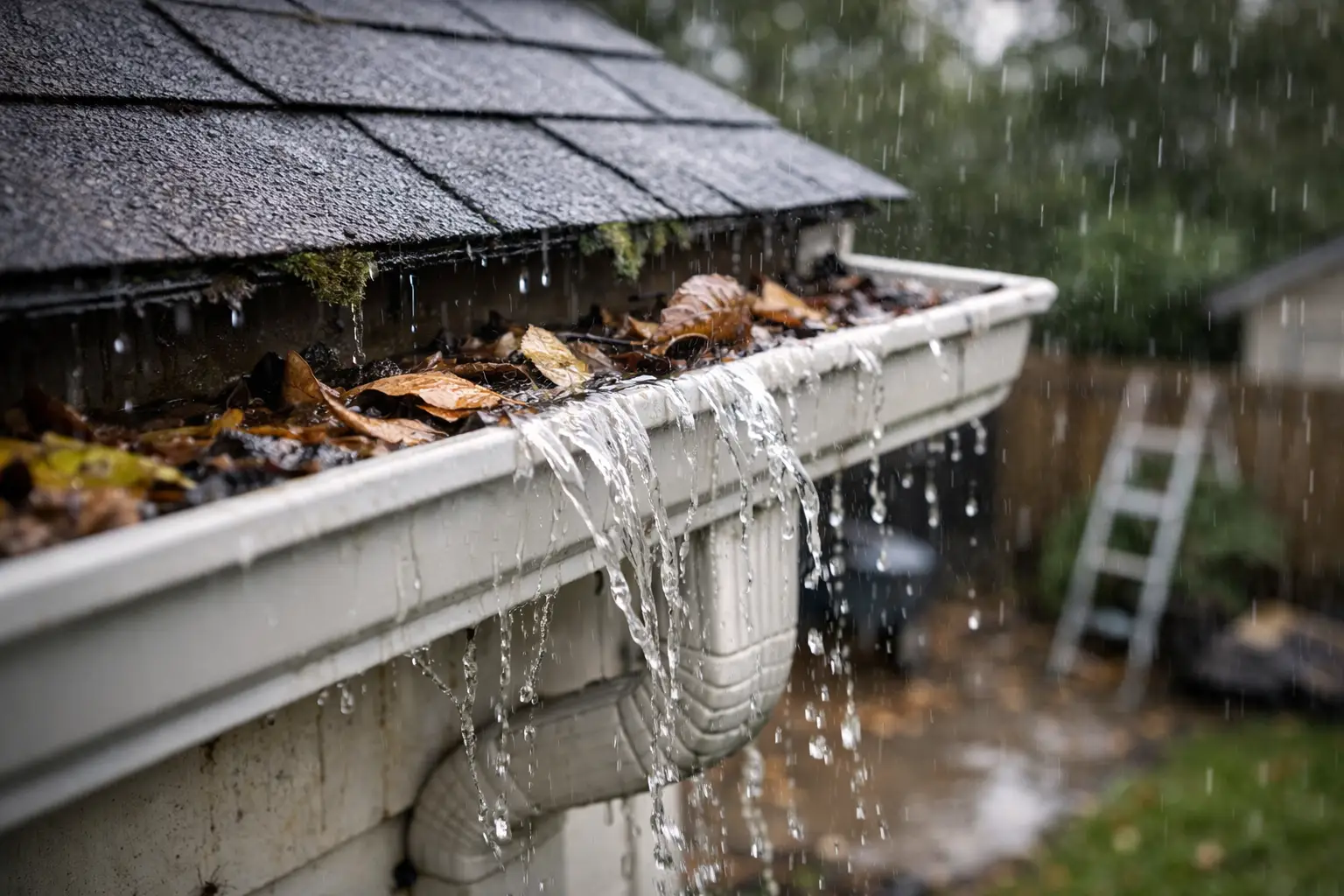
Water should travel quietly from your roof, through the gutters and down the downpipe. When it spills over the edge, runs down walls or pools around the property, the problem can quickly become more than an untidy nuisance. Knowing the gutter overflow warning signs gives you the chance to deal with a blockage before rainwater causes damp, damage or flooding.
A gutter can look fine from ground level while leaves, moss, roof grit and other debris are stopping water from draining properly. There is no need to climb a ladder to investigate. In fact, it is safer not to. Watch for the signs below and arrange a professional inspection if you spot them.
10 gutter overflow warning signs to look for
1. Water pouring over the gutter edge
This is the most obvious sign. During heavy rain, a small amount of splashing can be normal, particularly where a roof valley sends a lot of water into one section. But a steady curtain of water spilling over the front or back of the gutter usually means water cannot reach the downpipe fast enough.
The cause may be a compacted build-up of leaves and moss, a blocked outlet, or a gutter that has lost its correct fall. Left alone, that water can soak brickwork, fascias, soffits and the ground next to the house.
2. Water running down external walls
If rainwater is tracking down walls rather than through the downpipe, do not assume it will simply dry out without consequence. Repeated soaking can leave staining, encourage algae and allow moisture to find weaknesses around windows, render or mortar.
Pay particular attention to the wall beneath a gutter joint or outlet. A local leak can be caused by a failed seal or a section of gutter that is full and overflowing at one point. Either way, the gutter and downpipe need checking rather than just washing the wall afterwards.
3. Puddles close to the foundations
A downpipe should carry water away in a controlled direction. Puddles that appear beside the house after rain suggest that water is overflowing above, discharging from a blocked downpipe, or not reaching a working drain.
One wet patch after a storm may not be a major concern. Regular pooling is different. Water sitting against the base of a property increases the risk of damp and can create slippery paths, particularly in colder months.
4. Damp patches or peeling paint indoors
Not every damp patch is caused by a gutter problem. Condensation, plumbing faults and roof defects can also be responsible. However, if an internal damp mark appears on an upstairs external wall or beneath the edge of the roof, it is sensible to check the rainwater system first.
Overflowing gutters can repeatedly saturate a wall. Over time, that moisture may show inside as discolouration, flaking paint, bubbling plaster or a musty smell. Acting early is far less disruptive than waiting until internal repairs are needed.
5. Plants, moss or visible debris in the gutter
A few leaves caught in a gutter are an early warning. Thick moss, grass-like growth or a visible bed of debris means water flow is already restricted. Moss is especially common where roofs are shaded by trees or where it has washed down from tiles during wet weather.
Organic debris holds water and becomes heavy. It can block outlets, add strain to brackets and create a damp environment around the roofline. Clearing it properly also helps prevent the same material being pushed into the downpipe.
6. A downpipe that does not discharge during rain
When rain is falling and the gutter is filling, look at the bottom of the downpipe from a safe position. If little or no water is coming through, despite water overflowing at roof level, there is likely to be a blockage at the outlet or inside the pipe.
Do not attempt to force a blockage through from the top of a ladder. Downpipes can be packed tightly with wet leaves and moss, and simply shifting material can create a blockage further down. A proper clearance should deal with the gutter and downpipe as one system.
7. Sagging, pulling or uneven gutters
Gutters need a gentle fall towards the outlet. When they sag, bow in the middle or pull away from the fascia, water can collect in low spots instead of draining away. The extra weight from standing water and wet debris can make the problem worse.
This may be a cleaning issue, a bracket issue or both. Clearing the debris is often the first step, but damaged or loose fittings may also need attention. A clean gutter that still holds water is not doing its job properly.
8. Drips from joints long after rainfall
A small drip during a downpour may be difficult to notice. Dripping that continues after the rain has stopped is more revealing. It can point to water trapped in a sagging section, an overflowing joint, or a seal that has failed.
Gutter joints are common weak points because they handle changes in direction and connect separate lengths. If the same joint repeatedly leaks, it is worth having it inspected before water damages the fascia board behind it.
9. Staining on fascias, soffits or brickwork
Dark streaks, green growth and dirty marks beneath the gutter line are often evidence of repeated overflow. They may be most visible after a dry spell, when the wall has dried but the staining remains.
These marks are not just cosmetic. They show that water has regularly been where it should not be. Cleaning the staining can improve the appearance of the property, but the source of the overflow must be resolved first or it will return.
10. Overflow only happens in heavy rain
Some homeowners dismiss overflow because it only occurs during a proper downpour. Yet heavy rain is exactly when your gutters need to work reliably. A system that copes with drizzle but fails in Welsh weather is not providing enough protection.
There can be a trade-off here. Exceptionally intense rain may briefly overwhelm almost any standard gutter, especially where several roof slopes meet. But if overflow happens repeatedly in ordinary heavy showers, or always at the same point, it needs investigating. A blockage, poor fall, undersized section or badly positioned downpipe could be involved.
Why acting early protects more than the gutter
Blocked gutters do not only affect the gutter itself. Overflow can soak timber at the roof edge, stain render, wash soil from flower beds and leave water around entrances. Over time, persistent moisture can contribute to damp-related problems that are more expensive to put right than a routine clearance.
There is also the safety side. Homeowners often notice a problem in bad weather, then feel tempted to get a ladder out while surfaces are wet and windy. That is when a straightforward maintenance job becomes a fall risk. A professional gutter vac system allows debris to be removed from ground level while the system is inspected, without the usual need to work from a ladder.
When should gutters be cleared?
For many homes, a gutter clearance once or twice a year is sensible. Properties close to trees, with mossy roofs, or exposed to frequent wind and rain may need more regular attention. Autumn is an obvious time to clear fallen leaves, but a spring check is useful too, particularly after winter storms.
The right timing depends on the property. A bungalow beneath mature trees may need more frequent clearance than a newer home with little nearby vegetation. What matters is not waiting for water to pour over the side before taking action.
If you have spotted overflow, damp marks or a downpipe that is not draining, arrange a safe gutter and downpipe inspection before the next spell of heavy rain. A clear rainwater system is one of the simplest ways to keep water where it belongs – away from your walls, roofline and home.
Leave a Reply