A gutter can look fine from the ground while being packed with moss, leaves and roof debris. By the time water is spilling over the edge in heavy rain, the blockage may already be putting your walls, soffits and foundations at risk. This gutter vac system review explains why professional vacuum clearance is often a safer, more practical option than climbing a ladder and clearing gutters by hand.
What is a gutter vac system?
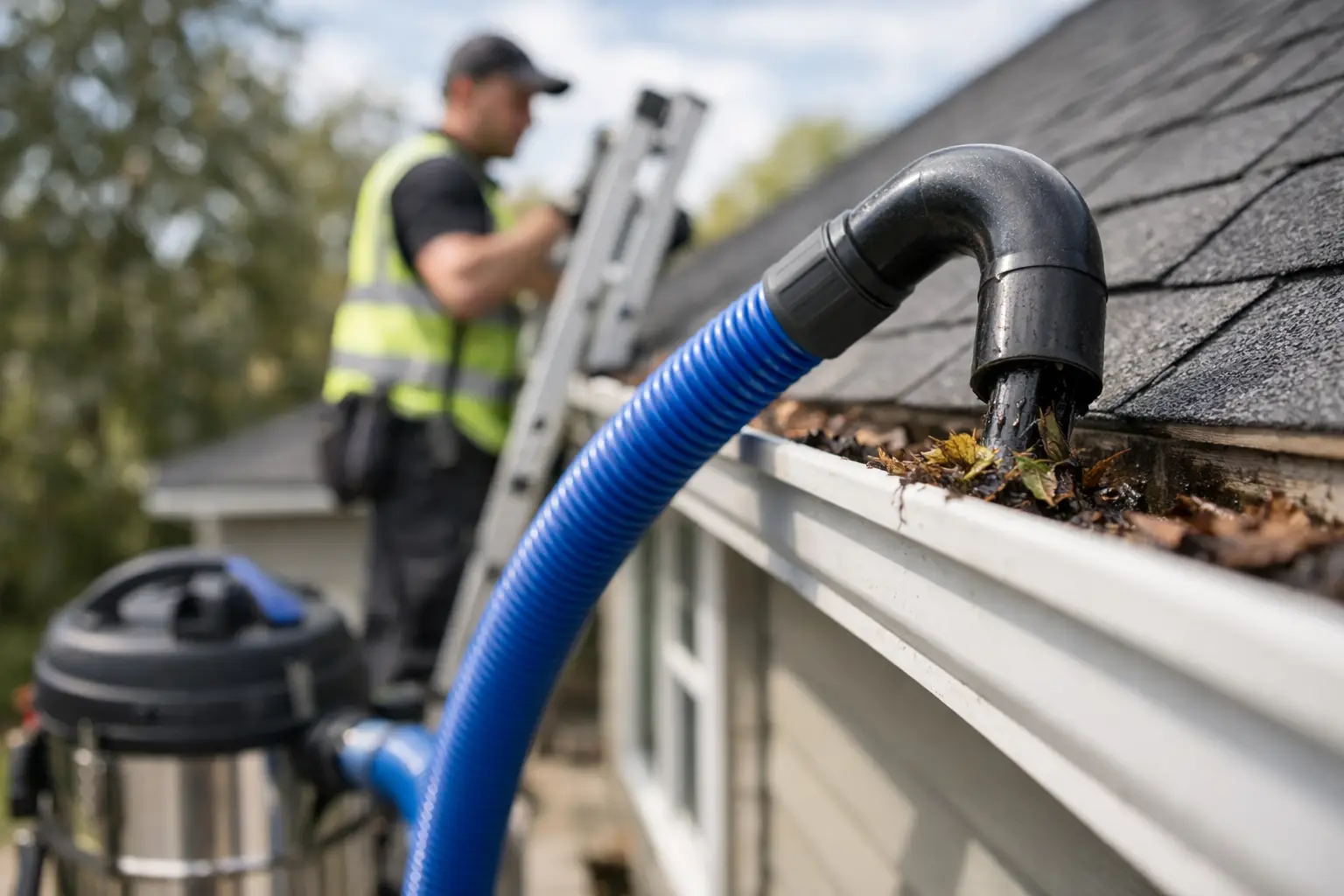
A gutter vac system is a high-powered vacuum connected to lightweight carbon-fibre poles. The operator works from ground level, guiding the pole into the gutter to remove leaves, moss, silt and other organic debris. A camera fitted to the pole allows the gutter to be checked before, during and after clearance.
The main benefit is straightforward: there is usually no need to place ladders against the property or walk on the roof. That reduces the risk of falls and avoids leaning equipment against gutters, tiles, cladding or rendered walls.
For homeowners, the result should be a clear route for rainwater to travel from the roofline, through the gutter and into the downpipe. That matters far more than simply making the gutter look tidy.
Gutter vac system review: the main advantages
The biggest advantage is safety. Clearing a low bungalow gutter with a ladder can be risky enough, particularly on uneven ground, wet paving or sloping driveways. On a two-storey house, the risk increases. A professional gutter vac lets the work be carried out with both feet safely on the ground.
It is also efficient. Rather than repeatedly moving a ladder, climbing up, clearing a short section and climbing down again, the operator can work around much of the property from ground level. This can be particularly useful where access is awkward, such as above a conservatory, over a porch, beside a garage roof or along a narrow side passage.
The camera inspection is equally valuable. Without being able to see inside the gutter, it is easy to miss a compacted blockage, a patch of growing moss or a section that has not cleared properly. A proper inspection gives a clearer picture of the condition of the rainwater system and provides reassurance that the job has been done thoroughly.
A gutter vac also removes debris rather than pushing it along the gutter. That is important because pushing leaves towards a downpipe can create a blockage lower down, where it is harder to spot. Vacuum clearance lifts out the waste so it can be disposed of properly.
What a gutter vac can remove
For regular maintenance, a gutter vacuum is highly effective at removing the usual causes of blocked gutters. This includes fallen leaves, moss from roof tiles, twigs, roof grit, mud, nests that are no longer active and the thick compost-like material that builds up when debris is left for several seasons.
This build-up is more than an inconvenience. Once wet debris forms a dam in the gutter, rainwater can back up and overflow. It may run down external walls, soak into masonry, saturate the ground around the property or spill onto paths and entrances. Over time, repeated overflow can contribute to damp, staining, damaged paintwork and problems with fascias and soffits.
The system is particularly useful in areas with mature trees, properties below mossy roofs, and homes that receive a lot of wind-driven rain. In Neath and across South Wales, wet weather and organic growth can make routine clearance a sensible preventative job rather than something to leave until there is an obvious problem.
Where a gutter vac has limits
A fair review should be honest about the limits. A gutter vac is excellent for removing loose and compacted debris, but it cannot repair damaged guttering. If a bracket has come loose, a joint is leaking or the gutter has dropped out of line, the issue needs to be identified and dealt with separately.
Very heavy, soaked-in debris may take longer to remove, especially if gutters have not been cleared for several years. In some cases, a stubborn blockage in a downpipe may need additional attention or testing with water once the gutter is clear.
Access also matters. Most standard domestic gutters can be reached with the right pole set-up, but unusual roof layouts, very high buildings and areas hidden behind extensions can require a different approach. A good contractor should assess the property rather than promise that one method suits every job.
There is another important point: clearing gutters does not mean ignoring the roof. If a roof is shedding large amounts of moss into the gutters, the cause should be considered. Roof cleaning may help reduce repeat build-up where it is suitable for the roof type and condition. The aim is not to disturb sound tiles or force work that is not needed, but to prevent the same debris returning every few months.
Why inspection matters as much as clearance
A blocked gutter is often only noticed after a problem develops. You might see water pouring over the edge, hear dripping behind the gutter, find green staining on the wall or notice damp patches inside an upstairs room. By then, water may have been going where it should not for some time.
Inspection allows problems to be spotted earlier. During a gutter clearance, it is worth checking whether water has a clear path to each downpipe, whether gutters are holding standing water and whether debris is collecting in particular corners. Repeated build-up in one place can point to an issue with the fall of the gutter, overhanging trees or a roof valley that deposits material in the same area.
This is why a camera-led gutter vac service offers more than a quick clean-out. It gives the homeowner useful visibility of an area that is difficult and unsafe to inspect without the right equipment.
Is it better than cleaning gutters by hand?
For a homeowner with a single-storey property, stable ground, suitable ladders and confidence working at height, hand clearance may seem like the cheaper option. But the saving can disappear quickly if a fall, damaged gutter or missed blockage leads to a bigger repair bill.
Working from a ladder also makes it difficult to inspect every section closely. Reaching across can be unsafe, while moving the ladder frequently is time-consuming. A gutter vac does not remove every possible maintenance need, but it is generally the safer choice for routine clearance, especially on two-storey homes and properties with difficult access.
The best method depends on the building and the condition of the gutters. What should not be optional is dealing with the debris before rainwater begins overflowing into places it was never designed to go.
How often should gutters be cleared?
Most homes benefit from gutter clearance at least once a year. Autumn is a common time because of fallen leaves, but properties near trees may need another visit in spring. Homes with moss growth on the roof, older gutters or known drainage issues may also need more frequent checks.
Do not rely only on what you can see from ground level. Look out for overflowing water during rain, vegetation growing from the gutter, damp marks beneath the roofline, pooling water near walls and downpipes that appear to be running slowly. These are practical signs that clearance should not be put off.
For landlords, regular gutter maintenance is a simple way to reduce the chance of a tenant reporting a leak or damp issue after a period of heavy rain. For homeowners, it is one of the less glamorous jobs that can help avoid a far more costly one later.
A professional gutter vac service from McQueen’s Exterior Cleaning is designed to clear debris safely from ground level and check that your gutters can do the job they are there for. If your gutters have not been inspected recently, arranging clearance before the next spell of heavy rain is a sensible way to protect the property and take the ladder risk out of the job.
Leave a Reply