
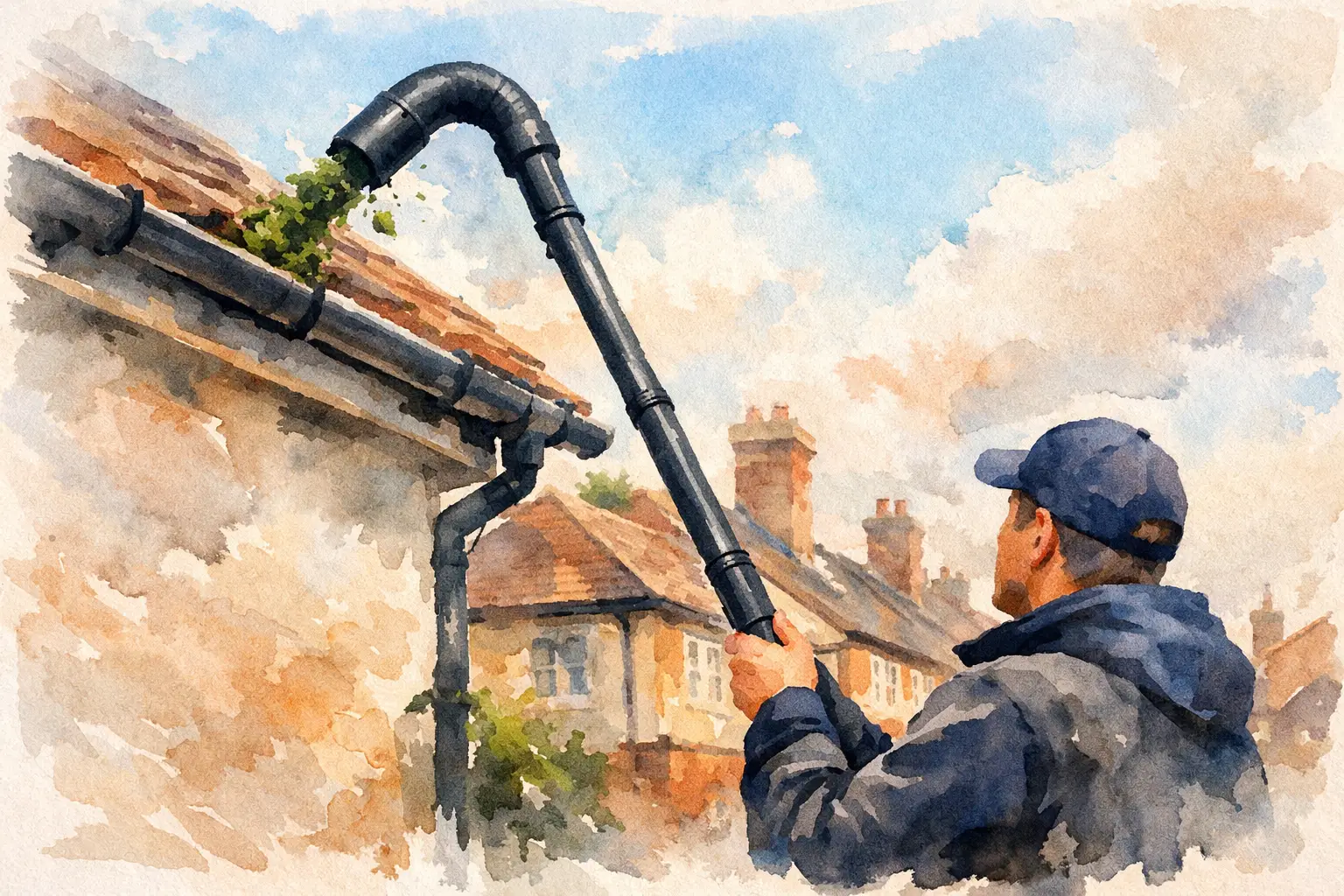
A guide to downpipe flow checks can help you spot a simple blockage before it becomes water running down your walls, pooling around the foundations or finding its way into the roof space. Gutters may look clear from the ground, but if a downpipe cannot carry water away properly, the whole rainwater system can back up when heavy rain arrives.
For most homeowners, the safest option is to have the gutters and downpipes inspected from ground level with professional equipment. There is no need to climb a ladder or lean over a roof edge to find out whether water is getting through. A proper flow check identifies where the water stops, why it is stopping and whether the issue is likely to cause damage to the property.
What a downpipe flow check tells you
A downpipe is the vertical pipe that takes rainwater from the gutter to a drain, gully or soakaway at ground level. When it is working as it should, water enters at the top and leaves freely at the bottom. A flow check confirms that route is open.
This matters because leaves, moss, roof grit and general organic debris do not always stay in the gutter. Rain can wash material towards the outlet, where it compacts inside the downpipe or at the bend near the bottom. Even a partial blockage can slow the water enough for the gutter to overflow during a Welsh downpour.
A flow check can also reveal problems that cleaning alone will not solve. The pipe may be disconnected, crushed, poorly aligned, leaking at a joint or discharging onto ground that cannot drain away. The right remedy depends on what is found. Clearing debris is useful, but it will not fix a broken bracket or a blocked underground drain.
Signs your downpipe may not be flowing freely
You do not need to wait for a visible flood to arrange a check. A few warning signs usually appear first, particularly after prolonged rain or autumn leaf fall.
- Water spilling over the front or back of the gutter
- Damp patches, staining or algae on exterior walls below the gutter line
- A dripping downpipe long after rain has stopped
- Water collecting at the base of the pipe or around a gully
- Gutter joints separating, sagging or leaking under the weight of standing water
- Plants, moss or debris visible at the top outlet of the downpipe
One sign does not always mean the downpipe is blocked. For example, an overflowing gutter may be caused by poor gutter alignment, while water at the base of the pipe may point to a blocked gully. That is why a flow check is more useful than guessing from the ground.
How professional downpipe flow checks are carried out
A thorough check starts with the obvious areas: the gutter outlet, the top of the downpipe, the joints and the point where water leaves the system. A technician looks for debris build-up, damaged fittings and signs that water has been escaping where it should not.
The gutter is then cleared where needed, including the material sitting around the outlet. This is a key part of the job. Testing a downpipe while the gutter remains full of moss and silt can simply move the blockage further down.
Once the route is clear enough to test, water is introduced in a controlled way and the flow is observed. The aim is not just to see water disappear from the gutter. It is to confirm that it travels through the pipe and reaches the intended drainage point without backing up, leaking or spilling onto the wall.
Where access allows, the bottom outlet or gully is checked too. If water reaches the bottom but sits there, the issue may be below ground rather than in the downpipe itself. That calls for a different type of drainage work, but identifying it early still prevents repeated gutter overflows.
At McQueen’s Exterior Cleaning, gutter clearance is carried out using a gutter vac system from ground level where possible. It removes debris without the unnecessary risk of householders climbing ladders, while allowing the rainwater system to be checked properly rather than treated as a quick tidy-up.
Why pouring water in from a ladder is not a good DIY test
It can be tempting to carry a bucket up a ladder and pour water into the gutter. In practice, this creates more risk than reassurance. Ladders can shift on uneven ground, wet surfaces reduce grip, and reaching sideways to pour water is exactly the sort of movement that can lead to a fall.
There is another problem: a bucket test can give misleading results. A large rush of water may jump over a partially blocked outlet, or overflow so quickly that you cannot tell whether the pipe itself is flowing. Equally, a small amount of water can pass through a narrow channel in the debris but fail when proper rainfall hits the roof.
Ground-level visual checks are sensible. You can look for overflowing gutters during rain, inspect for damp marks and make sure the lower outlet is not buried under soil, leaves or garden waste. Beyond that, professional equipment and safe working methods are the better choice.
Common blockage points to check
The gutter outlet is one of the most common trouble spots. This is where leaves settle and moss collects after being washed from the roof. If the outlet is restricted, water can rise quickly in the gutter even when the downpipe below is clear.
Bends and offsets are another weak point. Older properties often have sections where the pipe changes direction to avoid a window, bay or extension. Debris travelling down the pipe can lodge at these bends and gradually build into a solid blockage.
The shoe at the base of the downpipe also deserves attention. This is the angled section that directs water into a gully. Mud, leaves and gravel often gather here, especially where the gully cover is damaged or the surrounding area is not swept regularly.
Finally, do not overlook the drain itself. A clean downpipe cannot protect the property if its water has nowhere to go. If the gully is full, blocked or slow to empty, rain can pool against the wall and may eventually find weak points in brickwork, mortar or air bricks.
When should you arrange a flow check?
For many homes, checking gutters and downpipes at least once a year is a sensible preventative measure. Properties close to trees, exposed to heavy weather or affected by mossy roofs may need attention twice yearly, usually after autumn and again before the wetter months.
You should also arrange a check after noticing overflow, after a storm has brought down leaves and twigs, or if you have recently had roof work done. Small pieces of mortar, tile debris or packaging can easily end up in a gutter and wash straight towards the downpipe.
Landlords should be particularly careful with regular checks. A blocked downpipe can cause damage that goes unnoticed between inspections, and water ingress can quickly become a bigger problem once a property is occupied.
What happens after a failed flow check?
If the water does not pass through freely, the next step should match the cause. Loose organic debris can usually be removed during gutter clearance. A compacted blockage may require the downpipe to be cleared section by section. Damaged or disconnected fittings need repair, while a blocked gully or underground drain may need specialist drainage attention.
The practical point is to deal with the whole route of the water. Clearing only the visible gutter may buy a little time, but it does not protect the home if the downpipe remains blocked at the bend or the gully is already full.
A free-flowing downpipe is a small part of the property, but it does a vital job every time it rains. Checking it before the next spell of heavy weather is far easier than dealing with damp walls, overflowing gutters and avoidable repair bills afterwards.
Leave a Reply