
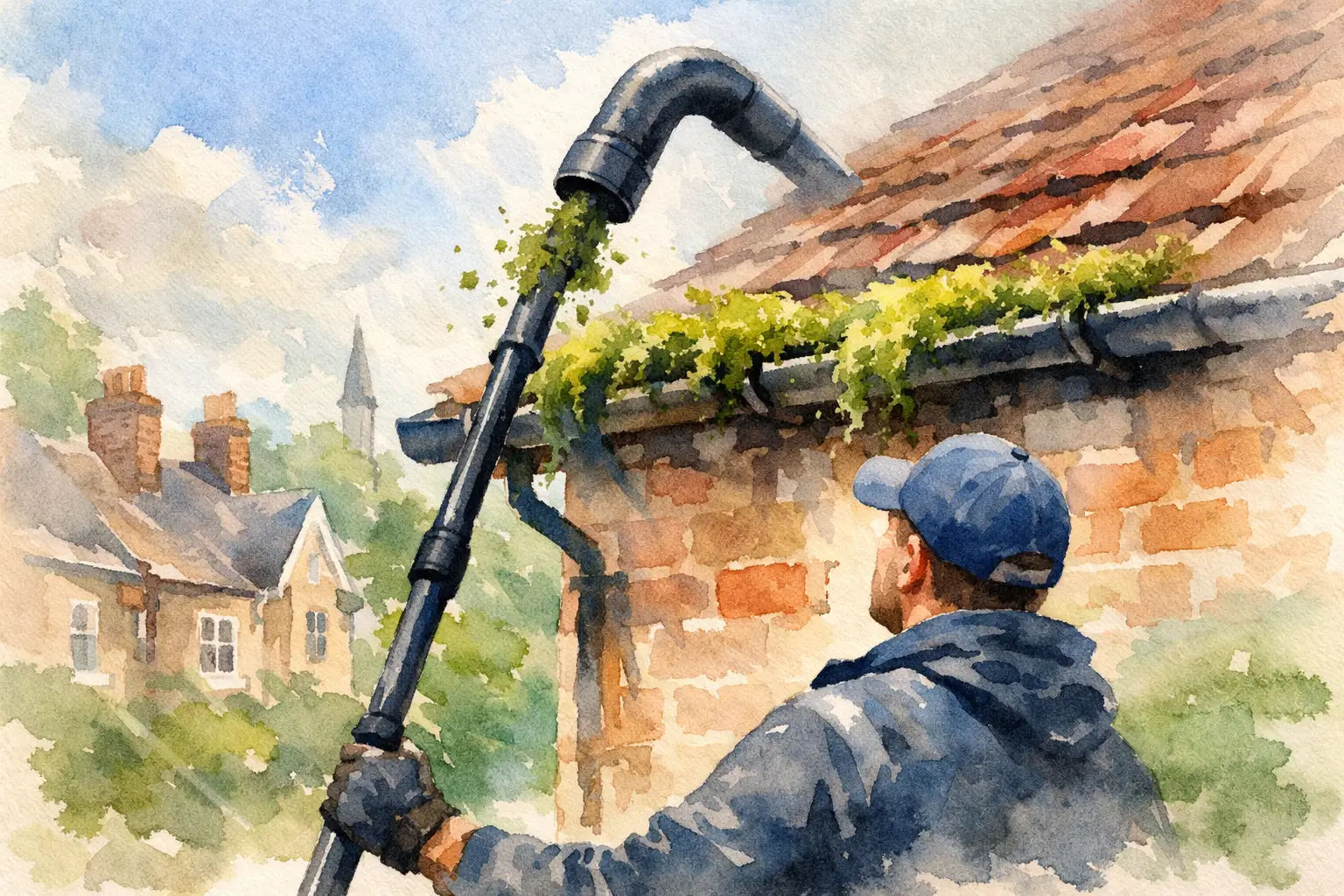
A strip of moss along the roof edge may look harmless from the ground. Once it reaches the gutter, however, it holds water, traps leaves and can quickly turn into a solid blockage. Moss buildup in gutters is not just a cleaning issue – it can stop rainwater reaching the downpipe and send it where it does not belong: over the gutter edge, down exterior walls and towards the property.
For homeowners and landlords, the sensible approach is to deal with it before heavy rain exposes the problem. Clearing gutters safely and checking that water can travel freely through the whole system is a straightforward piece of preventative maintenance that can avoid a far more expensive repair later.
Why moss builds up in gutters
Moss normally starts on the roof, particularly on shaded slopes that stay damp for longer. Rain gradually washes loose moss down into the gutter, where it mixes with leaves, twigs, roof grit and other organic debris.
A gutter is a good place for this material to settle. It is damp, sheltered and often contains enough fine debris for moss to take hold. Once there is a small bed of moss and leaf matter, it catches more debris every time it rains. The problem can build gradually, which is why a gutter may appear fine from below while being badly restricted inside.
Properties near trees, in shaded positions or exposed to wet weather often need more frequent attention. This is common across Neath and the surrounding area, where regular rain and vegetation can put rainwater systems under steady pressure.
What moss buildup in gutters can cause
The first issue is reduced water flow. Moss acts like a sponge, absorbing rainwater and swelling as it becomes wet. A gutter that copes during a light shower may overflow in sustained rain because the channel no longer has enough clear space for water to pass through.
Overflowing water often runs down the face of the gutter and onto walls, windows, fascias and soffits. Over time, this can leave staining, encourage algae growth and increase the risk of moisture finding its way into weak points around brickwork, render, window frames or roofline joints.
If the downpipe is blocked as well, the water has nowhere to go. You may see it spilling from a gutter joint, pouring over one section of guttering or backing up near the outlet. In colder weather, trapped water can freeze and add weight to the system. This can strain brackets, pull gutters out of line and cause joints to leak.
The concern is not only the visible overflow. Repeated water exposure can contribute to damp patches indoors, damaged timber around the roofline and saturated ground around the base of the house. None of these problems is guaranteed, and the outcome depends on the property and the condition of its roofline. But clearing the blockage early is much cheaper and simpler than waiting to find out.
Signs your gutters need clearing
You do not need to climb a ladder to spot every warning sign. Watch the gutters during rainfall from a safe position at ground level. Water spilling over the edge, dripping from joints or running down the wall are all clear signs that something is restricting the flow.
On dry days, look for moss hanging over the gutter lip, vegetation growing from the channel, dark staining beneath the gutter or a downpipe that appears to be carrying little or no water during rain. Sagging gutter sections can also point to the added weight of wet debris and standing water.
It is worth paying attention after autumn, following high winds and after periods of prolonged wet weather. A few leaves may not cause an immediate problem, but they can create the base that allows moss and other organic matter to collect.
Do not assume the downpipe is clear
A gutter can look clean near the top while a blockage sits at the downpipe outlet or further down the pipe. Moss breaks apart into dense clumps and can lodge at bends, especially when mixed with leaves and silt.
This is why a proper gutter clearance should include checking the gutters and downpipes, rather than simply removing what is visible from one section. The aim is to restore a clear route for rainwater from the roof to the drain.
Why clearing moss is not a job to rush
It is tempting to get a ladder out and scoop the gutter by hand. For some low, easily accessed properties this may be possible, but there is a real trade-off. Working at height on uneven ground, reaching across gutters or carrying tools up a ladder creates an avoidable risk of a fall.
There is also the risk of damaging the gutter. Forcing compacted moss with a hard tool can loosen joints, crack older plastic or push debris into the downpipe, where it causes a more difficult blockage. Pressure washing is not usually the answer either. Used carelessly, it can drive debris into pipework, make a mess of walls and disturb roof materials.
Professional gutter clearance is designed to remove the debris without putting the householder on a ladder. A gutter vac system can clear moss, leaves and silt from ground level while allowing the operator to inspect the work as it is carried out. It is a safer, more controlled way to deal with the problem, especially on higher properties or where access is awkward.
How often should gutters be cleared?
For many homes, an annual gutter clearance is a sensible starting point. The best time is often after the main leaf fall, when gutters have collected the most debris before winter rain sets in.
That said, there is no single schedule that suits every property. Homes beneath trees, properties with mossy roofs and buildings in shaded or exposed locations may benefit from checks twice a year. Landlords should also consider the condition of gutters between tenancies, particularly if a property has been empty or has not been inspected recently.
Regular maintenance is not about cleaning for the sake of it. It is about catching small accumulations before they become a blocked outlet, an overflowing gutter and a damp problem. If the roof has a heavy moss covering, gutter checks may need to be more frequent until the source of the debris is addressed.
Preventing moss from returning so quickly
You cannot stop rain carrying every loose piece of moss from the roof, but a few practical measures can reduce the rate at which it gathers. Keep nearby trees trimmed back where appropriate, as overhanging branches drop leaves and keep roof areas shaded. Make sure gutters are correctly aligned so water drains towards the outlet rather than pooling in low spots.
Gutter guards may help in certain situations, but they are not a complete solution. Fine moss and roof grit can still collect on top of or beneath them, and some guards make proper cleaning more awkward. Their usefulness depends on the roof, the type of debris and how easily the gutters can be maintained.
Roof moss treatment or roof cleaning can also reduce the amount of material reaching the gutter. This needs to be considered carefully, as the right method depends on the roof covering and its condition. The priority is always to protect the tiles and roofline, not to take a harsh approach that creates damage.
When to call for professional help
Arrange a professional inspection if you can see overflowing water, persistent moss growth, sagging gutters, leaking joints or signs of damp near the top of internal walls. It is also sensible to call if the property is tall, the ground is uneven or you are simply not comfortable working at height.
McQueen’s Exterior Cleaning provides gutter clearance using a gutter vac system, removing organic debris without the need for customers to climb ladders. The focus is on clearing the route for rainwater, checking for obvious issues and helping protect the property from the damage blocked gutters can cause.
A clear gutter is easy to overlook because it does its job quietly. Keeping moss and debris out of the system means that, when the next spell of heavy rain arrives, water has one simple place to go – safely away from your home.
Leave a Reply