
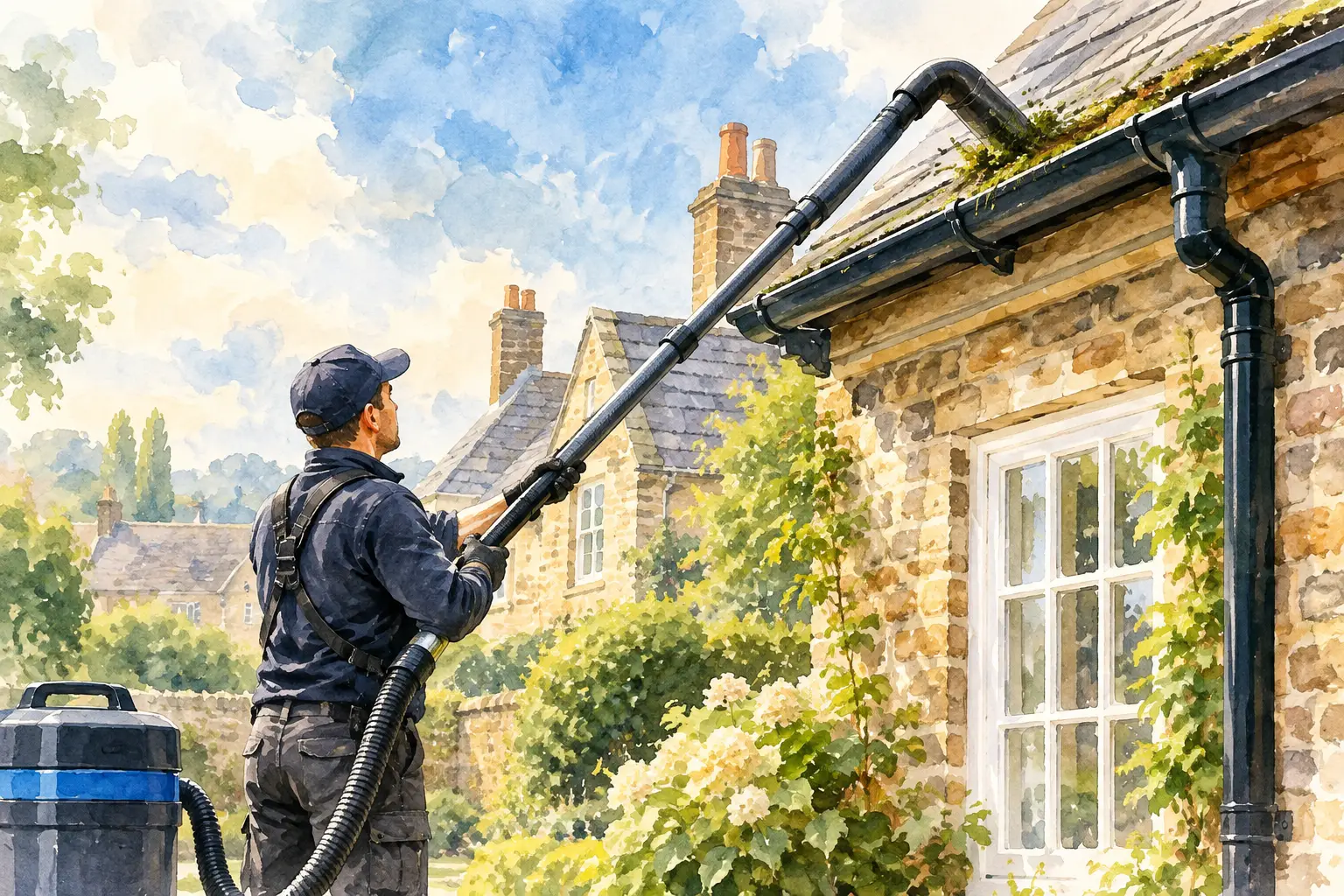
A gutter can look harmless from the ground while holding enough moss, leaves and roof debris to stop water moving properly. The future of gutter maintenance is less about waiting for an overflow and more about spotting trouble early, clearing it safely and keeping rainwater moving away from the house before damp takes hold.
For homeowners, landlords and occupiers, that is good news. Gutter care is becoming safer, more precise and more preventative. The aim is still simple: stop blockages causing overflowing gutters, soaked walls, damaged fascias and water ingress. The methods, however, are improving.
The Future of Gutter Maintenance Is Preventative
Too many gutters are cleaned only after a visible problem appears. Water pours over the edge during heavy rain, a damp patch develops inside, or a downpipe starts dripping where it should not. By then, the blockage may have been building for months.
A preventative approach works differently. Rather than treating gutter clearance as a one-off emergency job, it treats it as routine property protection. Regular checks remove organic debris before it compacts, breaks down and creates a solid blockage. They also give an opportunity to spot loose clips, sagging sections, joint leaks and downpipes that are not draining as they should.
This matters in South Wales, where wet weather, wind-blown debris and nearby trees can fill gutters quickly. A house beneath mature trees may need attention more often than a property in a more open location. There is no single schedule that suits every home, but a yearly check is sensible for many properties, with six-monthly visits often worthwhile where moss and leaves are a constant issue.
The real benefit is not a tidy-looking gutter. It is avoiding the much bigger cost and disruption that can follow repeated overflow. Rainwater belongs in the drainage system, not running down external walls or finding its way into the roofline.
Safer Clearance Without Climbing Ladders
For most homeowners, the biggest change is practical. Gutter cleaning no longer has to mean climbing a ladder with a bucket, reaching over the roof edge and hoping the ladder stays secure. Falls from height remain a serious risk, particularly when surfaces are wet or a homeowner is trying to work around awkward extensions, conservatories and uneven ground.
Modern gutter vacuum systems allow trained operators to clear debris from ground level using powerful suction and long lightweight poles. This reduces the need for ladders in many routine clearance jobs and allows hard-to-reach guttering to be tackled with far less risk.
That does not mean every property can be treated in exactly the same way. Very high buildings, damaged guttering, severely overgrown roofs or access restrictions may require a different method. A good service should assess the property rather than force one approach onto every job. Safety comes first, followed by a thorough result.
At McQueen’s Exterior Cleaning, gutter vacuum work is used to remove built-up debris from gutters and downpipes while keeping unnecessary ladder work to a minimum. It is a straightforward way to make a job that homeowners often put off much safer and more manageable.
Inspection Will Become More Important Than Guesswork
Clearing a gutter is only half the job. Knowing whether it is actually clear, correctly aligned and draining properly is what turns a basic clean into useful maintenance.
Camera inspection is becoming more common alongside gutter vacuum equipment. A camera on the end of a pole can give a clear view into the gutter line before and after clearance. It helps identify compacted debris, standing water, vegetation growth and sections where water may be sitting because the gutter has dropped or is poorly pitched.
For homeowners, this removes a common uncertainty. From ground level, it is difficult to tell whether a gutter is genuinely clear or whether loose leaves have simply been moved around. Visual checks give a better picture of the condition of the system and help explain when a repair may be needed.
There is a useful distinction here. Gutter clearance removes blockages. Gutter repair deals with faults in the system itself, such as cracked joints, missing brackets or poor falls. One does not replace the other. Regular inspections make it more likely that small faults are caught before they lead to repeated overflow or damage to timber and masonry.
Downpipes Need Equal Attention
A clear gutter is of little use if the downpipe is blocked below the outlet. Downpipes often collect leaf matter, moss and small twigs that have travelled along the gutter. Debris can lodge at bends or compact near the bottom, leaving water nowhere to go during a downpour.
The result may be easy to miss at first. Water can back up into the gutter and overflow at the nearest point, making it appear that the gutter itself is the only issue. A proper maintenance visit should consider the full rainwater route: gutter, outlet, downpipe and, where accessible, the connection at ground level.
Future-focused maintenance will increasingly look at this whole system rather than just the section visible from the front of the house. That is particularly useful for landlords and homeowners who may not notice a problem at the rear or side of a property until damp or staining has already appeared.
Gutter Guards Are Not a Complete Answer
Gutter guards and mesh covers can reduce the amount of large debris entering some systems. They may be useful on certain homes, especially where nearby trees regularly shed leaves. But they are not a fit-and-forget solution.
Fine moss, seed pods, grit from roof tiles and broken-down organic matter can still collect on top of, or beneath, guards. Some covers can also make cleaning more awkward if they are poorly fitted or become clogged. Water may run over the surface rather than through it during heavy rain.
Whether a guard makes sense depends on the roof, the type of gutter, the surrounding trees and how easily the system can be maintained. It should be viewed as a way to reduce debris, not as a replacement for inspection and clearance. A system that cannot be checked is not necessarily a system that is protected.
Weather Is Making Routine Checks More Valuable
Heavy rain does not create every gutter problem, but it exposes existing ones quickly. A gutter that copes with a light shower may overflow badly when persistent rain hits a blockage or a slow-running downpipe. Strong winds can also bring down more leaves, moss and small branches in a short time.
That is why the best time to think about gutter maintenance is not when water is spilling over the edge. Checking the system before autumn leaf fall, after prolonged bad weather, or before winter sets in gives problems less chance to develop unnoticed.
Homeowners should also pay attention to warning signs between professional visits. Overflowing water, staining on walls, dripping joints, plants growing from gutters, sagging runs and damp patches near the top of internal walls all deserve attention. None automatically means major damage, but each is a reason to inspect the rainwater system promptly.
The Best Future Is Simple, Regular Care
Technology will continue to improve how gutters are cleared and inspected, but the principle will not change. Rainwater needs a clear route away from the building. Keeping that route open protects the roofline, walls and foundations from unnecessary moisture.
The most sensible plan is usually a regular professional check based on the property and its surroundings, not a rushed climb up a ladder after trouble starts. A clean, properly draining gutter is a small piece of maintenance that can prevent a great deal of worry when the next spell of heavy rain arrives.
Leave a Reply