
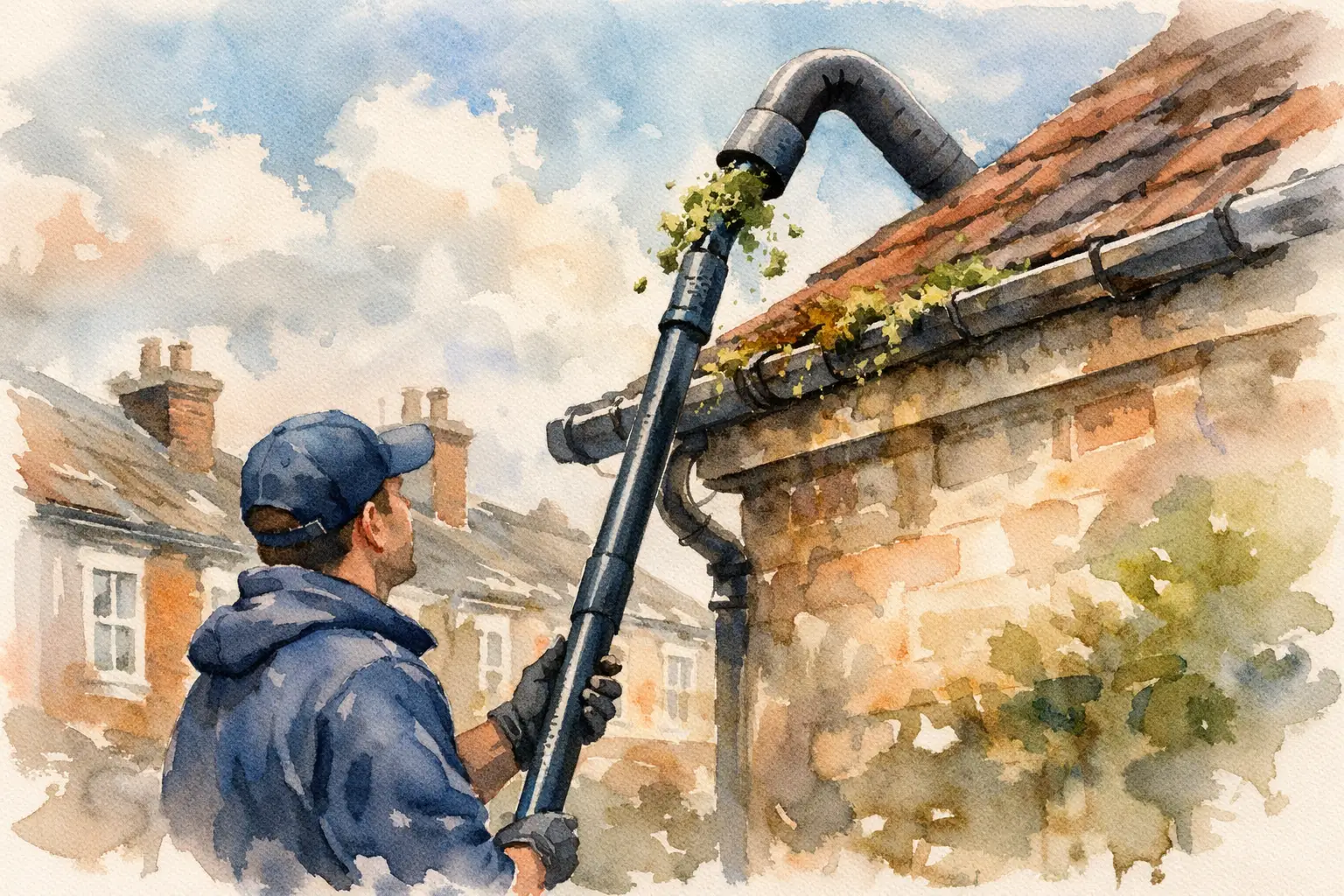
A blocked gutter can look like a small job from ground level. Leaves sit out of sight, rainwater still appears to run away in places, and the problem is easy to put off. But this example of neglected gutters and damp damage shows how quickly a simple blockage can turn into staining, mould and costly repairs inside the home.
For homeowners, landlords and occupiers, the main point is straightforward: gutters are there to move water safely away from the building. When they cannot do that, the water has to go somewhere else. Too often, that means down external walls, into roof edges, behind render or towards the foundations.
A neglected gutters damp damage example
Picture a typical semi-detached house after autumn. The guttering along the rear elevation has filled with wet leaves, moss from the roof and small twigs. One downpipe is partly blocked at the top, while the other is clear enough to give the impression that everything is working.
During a light shower, there is no obvious concern. During a prolonged spell of Welsh rain, however, water backs up along the gutter channel. It reaches the high point, spills over the front edge and repeatedly runs down the brickwork below.
At first, the owner notices dark lines on the wall and a damp patch close to the upstairs window. They assume it is a problem with the window seal. A few weeks later, the patch has spread inside the bedroom, the paint has started to bubble and a musty smell develops behind a chest of drawers.
The cause is not necessarily a failed roof or a major plumbing leak. It may simply be rainwater overflowing from a gutter that has not been cleared. The water is hitting the same area of wall every time it rains, soaking into materials that were never intended to manage that amount of water.
This is why gutter maintenance is preventative work, not just a tidy-up. Clearing the blockage before wet weather arrives is usually far simpler than tracing damp, replacing damaged plaster or dealing with mould once moisture has entered the property.
How overflowing gutters lead to damp
A gutter system works as one route. Rain lands on the roof, flows into the gutters, travels down the downpipes and discharges away from the building. A blockage anywhere in that route can cause a back-up.
Leaves and moss are common causes, but they are not the only ones. Silt can settle at the bottom of the gutter and form a heavy sludge. Grass, weeds and even small saplings can grow from built-up debris. Loose joints or badly aligned sections can make matters worse because standing water may collect in one place instead of moving to the outlet.
When water repeatedly spills over, several types of damage can follow. External walls can become saturated and show dark staining or green growth. Fascias and soffits may remain wet, which can lead to rot in timber components. Water can also find its way around window openings, into roof eaves or through existing small cracks in render and masonry.
Inside, the signs may be less obvious at first. You might see peeling paint, flaky plaster, tide marks on a wall or mould forming in a cold corner. These symptoms do not automatically prove that gutters are the cause. Condensation, defective pointing, roof faults and plumbing leaks can all create damp too. But if the affected area sits directly below an overflowing gutter or leaking joint, the rainwater system should be inspected early.
Why the damage often goes unnoticed
Gutters are high up and most people only look at them when something is already dripping or overflowing. By that point, debris may have been building up for months. A dry spell can also hide the problem completely.
It is easy to assume that a gutter is clear because water is coming out of the bottom of a downpipe. Yet a partial blockage can still cause water to back up during heavy rain. Equally, one section of gutter may be working while another is holding water behind a clump of moss.
Properties with nearby trees need particular attention, especially after autumn and following high winds. Homes with mossy roofs may also need more regular checks, as moss can break loose and collect around outlets. There is no single cleaning schedule that suits every property. For many homes, an annual clearance is sensible; heavily treed areas or properties with recurring moss may benefit from checks twice a year.
The warning signs worth acting on
You do not need to climb a ladder to spot every issue. In fact, climbing up to inspect or clear gutters without the right equipment is where many household accidents happen. Look from the ground after rainfall and keep an eye out for a pattern rather than one isolated drip.
The following signs are good reasons to arrange a professional inspection:
- Water pouring over the gutter edge or running down the wall during rain.
- Plants, moss or visible debris growing from the guttering.
- Damp marks, peeling paint or mould on internal walls near roof level.
- Staining on brickwork, render, fascias or soffits beneath the gutter line.
- Guttering that looks bowed, loose or full of standing water.
A blocked downpipe can be just as important as a blocked gutter. If rainwater cannot leave the system, it will back up and overflow at the weakest point. Clearing both the gutters and downpipes gives the system the best chance of doing its job when heavy rain arrives.
Clearing gutters safely makes a difference
The temptation is to put a ladder up and remove the visible leaves by hand. For a single-storey extension with safe access, some confident homeowners may choose to do that. But there are real trade-offs. Ladders can be unstable on uneven ground, wet gutters are slippery, and reaching or leaning too far is a common cause of falls.
There is also the issue of what cannot be seen. Scooping debris from one spot does not confirm that the outlets, corners and downpipes are clear. If compacted silt remains around the downpipe opening, the next downpour can expose the same problem again.
A professional gutter vac system allows debris to be removed from ground level without the need for ladders in many situations. It is a safer approach and makes it easier to carry out a proper clearance of the gutter run. A thorough service should also identify visible problems such as overflowing points, damaged joints or sections that may need further repair.
McQueen’s Exterior Cleaning uses specialist gutter vacuum equipment to remove organic debris from gutters and downpipes safely and efficiently. The aim is practical protection: keep rainwater moving away from your home and reduce the chance of avoidable damp damage developing.
When damp needs more than a gutter clearance
A gutter clearance can stop more rainwater from entering the same area, but it cannot instantly dry a wall that has been wet for months. Once the cause is addressed, the affected fabric needs time to dry out. Redecorating too soon can trap moisture and lead to paint failure again.
If there is extensive mould, crumbling plaster, a persistent roof leak or signs of decayed timber, additional repair work may be needed. In those cases, clearing the gutters is still worthwhile because it removes one possible source of water while the wider issue is assessed.
The key is not to wait for a small damp mark to become a large internal repair. If gutters are overflowing, vegetation is visible at roof level or water is regularly running down the walls, arrange a safe clearance and inspection. A clear rainwater system is one of the simplest ways to give your property a better chance in the next spell of heavy rain.
Leave a Reply