
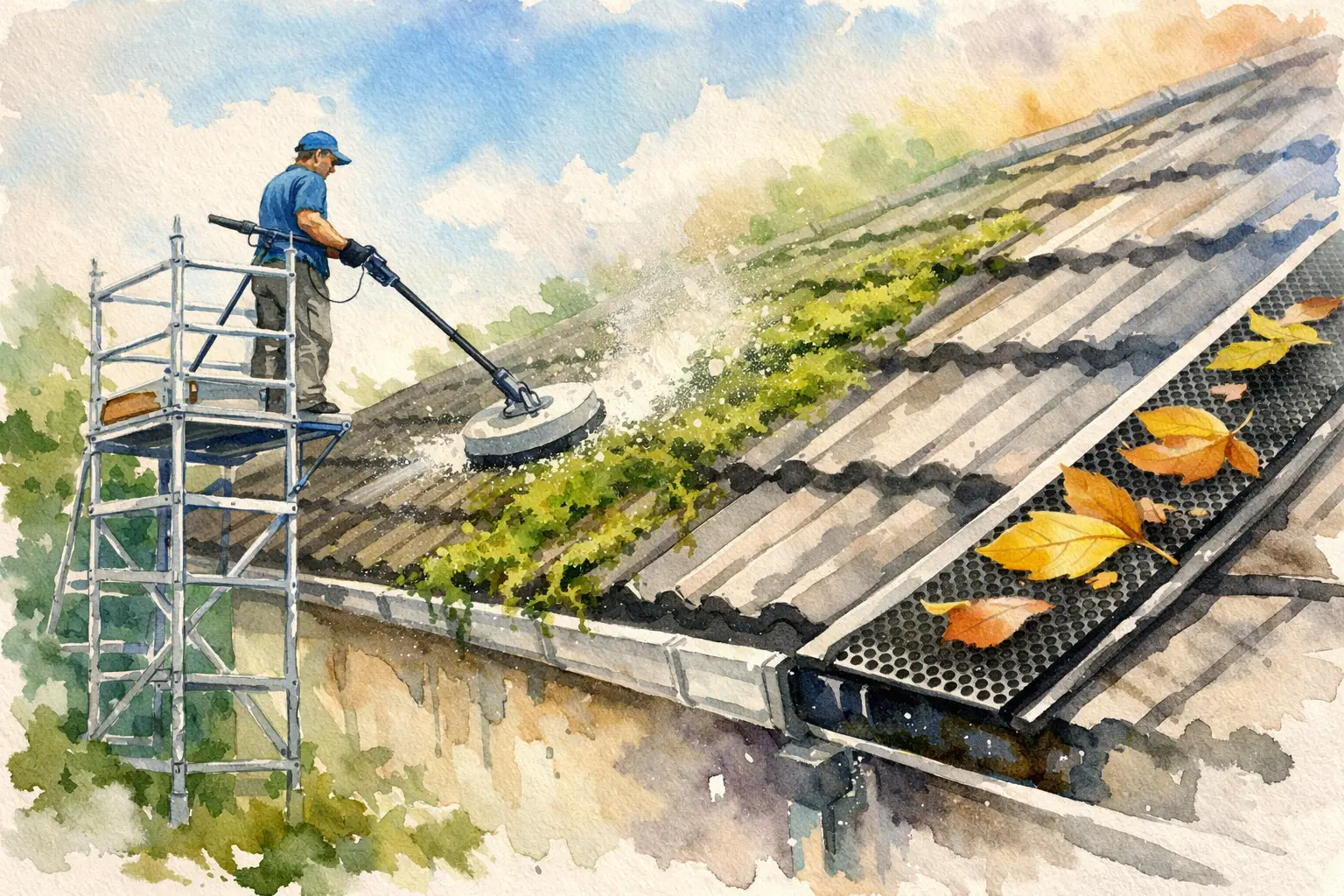
A gutter guard can look like a simple answer to a messy problem: fit it once, forget about leaves forever. In reality, gutter guards versus cleaning is not an either-or choice for most homes. Guards can reduce the amount of debris entering a gutter, but they do not stop moss, roof grit, seeds and wet leaves collecting around the system. Your gutters and downpipes still need checking and clearing if you want rainwater safely away from the property.
For homes in Neath and across South Wales, that matters. Frequent rain, nearby trees and moss growth on roofs can quickly turn a small build-up into an overflowing gutter. The result may be water running down walls, pooling near the foundations, damp patches and damage that costs far more than routine maintenance.
What gutter guards actually do
Gutter guards are covers, screens or inserts designed to sit over or inside the gutter. Their job is to let rainwater through while keeping larger debris, such as leaves and twigs, out. There are several designs, from simple plastic mesh to metal screens and fitted systems that use a narrow slot to direct water into the gutter.
A suitable guard can be useful where a property sits beneath mature trees or regularly receives large leaves. It may slow down the rate at which a gutter fills, reduce visible leaf build-up and make cleaning less frequent in some cases.
That is the benefit. The limitation is that a guard is a filter, not a self-cleaning system. Fine debris still gets through. Moss fragments from roof tiles can form a dense, wet layer in the gutter. Seeds, silt and roof grit can gather beneath the guard, while leaves can settle on top and block the openings. In heavy rain, a covered gutter that is already partly blocked can overflow just as readily as an uncovered one.
Gutter guards versus cleaning: the practical difference
Gutter guards are a preventative measure. Gutter cleaning removes the debris that is already there and allows the whole rainwater system to be checked. One does not reliably replace the other.
Professional cleaning deals with the areas a guard cannot solve on its own: compacted debris at the bottom of the gutter, blocked downpipes, joints holding stagnant water and outlets choked with moss. These are often the hidden causes of an overflow. From ground level, a gutter may look tidy while water is unable to drain through the downpipe.
Cleaning also gives you an opportunity to spot early warning signs. A section of gutter may be sagging, a bracket may be loose, or water may be tracking behind the gutter rather than into it. Catching these issues early helps protect fascias, brickwork and internal walls.
For that reason, the better question is usually not, “Should I have guards or cleaning?” It is, “Will guards make sense for my property alongside regular inspections and clearance?”
When gutter guards can be worth fitting
Guards tend to make most sense when there is a clear, ongoing source of larger debris. A home beneath broadleaf trees may benefit from a good-quality guard, particularly if leaves repeatedly fill the gutter between maintenance visits. They can also be useful on straightforward rooflines where the product can be fitted securely without interfering with water flow.
Even then, choose carefully. Cheap mesh can become brittle, lift in bad weather or trap debris against the gutter. Some systems are difficult to remove for cleaning, which can make a future blockage harder to deal with rather than easier. A guard should not obstruct roof drainage, alter the gutter’s fall or make inspection impossible.
It is also worth considering the type of debris your roof produces. If moss is the main issue, guards may offer less benefit than expected. Small moss pieces can pass through many guard types, and larger clumps may sit on top of the cover until rainwater cannot get in. In that situation, roof maintenance and regular gutter clearance are often more useful than relying on a cover.
When regular cleaning is the better choice
For many properties, professional gutter cleaning is the simpler and more dependable option. It removes what is causing the problem now, rather than trying to reduce what may enter later. It is particularly suitable for homes with mossy roofs, older guttering, awkward roof shapes or downpipes that have previously blocked.
A clear gutter must still have a clear route to the drain. That is why downpipe clearance matters as much as the gutter channel itself. If the downpipe is packed with leaves and sludge, rainwater has nowhere to go. It backs up, spills over the front or rear edge, and soaks areas of the property that were never meant to handle that volume of water.
A professional gutter vac system allows debris to be removed from ground level, avoiding the unnecessary risk of climbing ladders for routine work. It is a safer approach for householders and allows the gutter line to be inspected properly while the work is carried out. McQueen’s Exterior Cleaning uses this method to clear organic debris from gutters and downpipes without turning a maintenance job into a fall risk.
The costs to compare are not just the upfront costs
A gutter guard has a fitting cost, and better products cost more than basic plastic screens. It may reduce cleaning visits in the right setting, but it should still be inspected and cleared. If debris builds up beneath it or along its surface, removal and cleaning can take longer.
Regular cleaning has a more predictable cost. You pay for the debris to be removed, the downpipes to be checked and the rainwater system to be assessed. There is no assumption that the gutter is fine simply because it has a cover on it.
The greater cost is what happens when neither option is handled properly. Overflowing water can stain walls, encourage damp, damage timber fascias and expose small defects around roof edges. Landlords should be especially cautious, as blocked gutters can become a preventable maintenance issue that affects tenants and the condition of the building.
How often should gutters be cleaned?
Most homes benefit from gutter clearance at least once a year. Properties near trees, with a moss-heavy roof, or those that have suffered blockages before may need attention twice a year. Autumn is a sensible time after leaf fall, while a spring check can clear winter debris and confirm the system is ready for heavier rain.
Do not wait for water to pour over the edge before arranging a clean. By that stage, the blockage may have been holding water for some time. Look out for plants growing from the gutter, staining below the gutter line, dripping long after rain has stopped, damp patches near external walls, or water running from gutter joints rather than down the downpipe.
If guards are fitted, keep the same inspection habit. Check that the guard has not shifted, that leaves are not sitting across it, and that water is entering the gutter freely. A guard that is out of sight should not be out of mind.
A sensible approach for most homes
The most reliable plan is simple: keep the rainwater system clear, inspect it regularly, and use gutter guards only where the property genuinely benefits from them. A good guard can reduce larger leaf debris. It cannot guarantee a blockage-free gutter, especially in wet areas with roof moss and windblown material.
Your gutters are there to move thousands of litres of rainwater away from the house. Treating them as a small preventative job, rather than waiting for an overflow, is one of the simplest ways to avoid damp, flooding and an avoidable repair bill.
Leave a Reply